Saturday, 11 May 2013

Leverage Strategy No. 4 - Alignment


In combat martial arts we create leverage in our techniques by aligning our bodies to create more force for less effort. For instance on a lead leg side kick we can multiply our body weight in the delivery of the kick by aligning our head, hip and heel. If we make contact with these three body parts in a straight line from the kicking foot to the hip and to the head we can generate more force for less effort. 

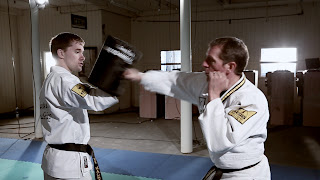
On a right cross or left jab we do the same a strong and bio-mechanically correct technique creates force not just through speed and strength but by aligning the body in such a way as to deliver the most body weight we can. The difference between a heavy puncher and a light puncher in a boxing match is not their weight differences as there isn’t much of that but in how they apply the technique. If you examine the position of a fighter delivering a knockout technique you will often observe that his fist, elbow, shoulder, hip and both feet are closely aligned to maximise his leverage or force.

In life we can align with others who have similar aims such as a political pressure group, an association or organisation. Consider here the similarities between these first 4 leverage stratagems. Recruitment is you recruiting others to create leverage, tiring them is you persuading the opponent to use all his leverage, isolation is the opposite of recruitment and alignment is effectively joining someone else’s army. To fully understand strategy and how to use it you must consider how the different strategies contrast and compare. Without this you can never fully master them which if you think about it removes the leverage that you could have exerted had you studied them well enough.

Best wishes

Tony Higo
8th Degree Black Belt
Chief Instructor - National Martial Arts Colleges - UK
www.nat-mac.co.uk
0800 092 0948

Friday, 10 May 2013

Leverage Strategy No.3 - Isolation Strategy


In application against an adversary we can de-leverage him, that is; to remove what leverage he has and one stratagem is to isolate him, send him to Coventry for instance, meaning to isolate him from communication or assistance. 

In these terms it means to cut him off from his friends but it could also be used in competition by ‘cornering’ him as in boxing or kick boxing when we press an opponent into the corner of the boxing ring. The smaller space affords him little room to move and therefore removes part of his army which are his techniques. If you face an opponent who is a good kicker but not too good at boxing you can virtually cut off his legs by trapping him in the corner where he has no space to use them and where you can leverage your position, having de-leveraged or isolating his weapons.

In warfare we can surround our opponents or separate one section from their army from another destroying this force before we move onto another section, gradually isolating and defeating the target section by section. 

In wildlife programs we can often see where lions or some other type of predator will hunt a heard of buffalo harrying them one way and then another, then they target a weaker individual, probably a bull calf and work to separate it from the herd. Once they can separate it its leverage of safety within the herd is removed and it becomes an easy target. 

Thursday, 9 May 2013

Leverage Strategy No. 2 - Recruit Strategy


In an earlier article I discussed the difference between a warrior and a warlord and how the warrior lacks leverage as he can only utilise his own energy or skill whereas the warlord has progressed to his lofty position by utilising the energy of others. The warlord recruits an army to fight for him and so can achieve bigger results. Imagine Lord Sugar for instance; how well known would he be today if he had never leverage himself up by recruiting his own army of staff to take on the tasks that he had no time to do. We would never have heard of him as he would have remained a warrior instead of promoting himself to the warlord status. 

I have deliberately used a non-martial arts example to demonstrate that though we learn these strategies through the martial arts, they are by no means limited solely to the martial arts. When we understand this we can leverage our skills into more areas of our lives which is why the ancient masters encouraged us to deepen our knowledge through practice in order to more fully understand our art. To fully understand means to recognise that our martial arts skills can be put to much more use than just fighting. Even the great swordsman Miyamoto Musashi, though he never built an army or aspired to progress through Japanese society as he no doubt could have still leveraged his skills. We know him as a sword master victorious in over 60 ‘death matches’ but he was also a gifted poet and extremely gifted artist. He mixed with some of the most powerful families in feudal Japan socially because he leverage his skill to recruit an army of friendly but powerful people who he could stay with or work for as and when he needed to. His fighting skill was leveraged to advance him socially which gained him the support of people who could assist him when necessary.

As with all the 25 FLITE stratagems they can be used in many situations if we take the time to study how we can apply them. Sadly I do not have space here to explore them in detail but you might wish to keep your eyes open for my upcoming book on strategy which will be available later this year if you want to study the subject in detail. 

Best wishes and have a great day

Tony Higo
Chief Instructor
National Martial arts Colleges UK
www.nat-mac.co.uk
080000928948

Monday, 6 May 2013

Leverage Strategy No. 1 - Take the Wind Out of His Sails


The first leverage strategy is concerned with utilising your opponents’ energy so that he wears himself out. Like the bull fighter against the bull, the animal has greater strength, weigh and speed plus sharp horns so on the face of it he has the best chance of winning but the matador creates targets for the bull to charge again and again so that it becomes exhausted. Once it is exhausted its natural gifts of strength, weight and horns are nullified as it no longer has the energy to utilise them, it then becomes more malleable and becomes an easier kill.

This strategy also works by getting ones enemy to exhaust his resources; getting him to waste his money, spreading himself too thin or overextending himself financially. The strategist calculates how to encourage ones target to think that his time, money or resources will solve the problem and like the charging bull he thinks only of attacking and not of the consequences.

Once we understand leverage we can observe how others waste their energy running around like headless chickens thinking that working harder or faster will accomplish the task when their experience should already have told them that it is not working. A self-employed contractor may have freed himself from the chains of his employer only to find that he has chained himself to having to do everything now in his new business. Long hours, heavy work and having to do all the tasks of the business can soon wear him out unless he can recognise that this strategy of doing everything his self cannot work indefinitely. When he recognises this and starts to leverage the help of others to help him achieve his tasks he may initially find that he is earning less but has more energy and a more balanced view of his business with which to make it grow.

In competition and faced with and strong, muscular opponent that we cannot match for strength we can be elusive and annoying, hitting and running, refusing to be drawn into a war of attrition, exchanging blows that will get us damaged and instead getting our opponent more and more frustrated so that he chases and chases until like the bull he becomes exhausted and an easy target for our best shots and giving you a seemingly easy win.

Saturday, 4 May 2013

The 5 Leverage Strategies


Last time we discussed the first 5 strategies of the FLITE stratagems. You might remember that over the last couple of weeks we have looked at how martial artists need to understand strategy at a deeper level than is often taught in class.

My goal in my schools is to not only use strategy but to understand it as deeply as possibly; like the number of repetitions of technique it takes to begin to understand a technique the practice and application of strategy will over time reveal more subtle levels of comprehension and understanding. My contention is that martial arts is not about winning, but about getting the results we want. What do I mean by that seemingly contradictory statement? Well, let me explain:

It’s easy to set a goal for something in life whether it is something material like a bigger house, emotional like the partner of our dreams or physical like the body of an Adonis. At the beginning we attempt to achieve our goals and the goal itself gives us direction but it is the journey that reveals the most to us. In our quest and pursuit of the goal we learn about its achievement through the strategies we use to achieve it but along the way we are acquiring valuable skills that we can use in the pursuit of other life goals too.

So even if we don’t achieve the exact goal or if we do it doesn’t matter as much as the knowledge we acquire on the way. Just as when we first enter the dojo because we want to do ‘a bit’ of martial arts or to get fit or to learn to defend ourselves, the initial goal gives us a direction but for some of us we realise that what we came for is not the real goal but the journey of discovery of ourselves using the martial arts as our tool. Winning trophies in competition might be another goal and you might win many or lose them all. The winning or losing though in the long run doesn’t matter as when you are older and perhaps wiser you look back on your tournament career and see that the acquisition of trophies matters little as no one really cares about your past, but the important things is what you have gained along the way: friends, skills, practice, conditioning and experience that will serve you for the rest of your life.

Martial arts study is like polishing diamonds, when the rock is lift from the ground it is shapeless, grubby and dirty like any rock but when the polisher begins his work on polishing and shaping the rock, beneath all that dust emerges what it really is; a lustrous, beautiful diamond.

The martial arts; through sustained and dedicated study, reveals the diamond that is us; at our core it reveals our true values and shapes our futures. So the consideration or mind-set of the ‘win’ becomes irrelevant when compared with what we have become, all the so called wins and losses fade away when compared with what we have gained on both sides of that coin and ultimately we have gotten what we really wanted – knowledge or ourselves and our purpose in life.
So it is with the martial arts that we can think beyond the simple win or lose scenario and in so doing consider how to get what we want quicker, easier and with less pain. Without strategy we can be like the poor bulls that face the bull fighters of Spain; simply charging forward with huge power and strength, all of which is simply controlled and manipulated by a tiny human with a fraction of that strength but who knows how to use strategy to get what he wants. Sadly with bull fighting the humiliation of a bull seems to me to be at best a waste of good strategy and at worst a torture of a proud animal. So my goal in these articles is to encourage you to consider the various tools that are available to us in the form of strategy so you are not simply charging forward like the bull who utilises the same strategy over and over again only to be easily controlled and shortly killed.

Last time we discussed the first 5 stratagems which are the focus strategies using the fake, feint, foil, draw and doubt. These work very well in combative opposition and are most easily understood. Over the next few blogs I want to cover the next five stratagems which are the 5 Leverage strategies.

All strategy uses leverage at some level to get what we want but the 5 leverage strategies are more heavily focused on understanding and utilising our available leverage. The combat law of Leverage states ‘achieve more with less’ and refers to how we can find in every situation an easier way to achieve our preferred outcome.

I look forward to discussing this with you in more detail.

Tony Higo
Chief Instructor
National Martial Arts Colleges - UK
www.nat-mac.co.uk
0800 0920948

Thursday, 2 May 2013

Focus Strategy No. 5 – The Doubt


The fake tricks your opponent into going the wrong way, the feint in taking too seriously or not seriously enough the danger, the foil nullifies and confuses an opponent physically and mentally, the draw offers oneself as a target, the final focus strategy tricks an opponent into focusing within. 

Self-doubt is often down to a lack of confidence and many competitors compete to overcome self-doubt or feelings of a lack of self-worth. In combat if one can destroy an opponent’s confidence you can win before he even steps onto the tournament floor. When a fighter doubts that he can win he is often already beaten for instance if you are novice fighter and you step onto the mat against someone you know is a world champion then immediately you experience feelings of self-doubt. 

As a strategist using the stratagem of doubt you must convince your opponent that it’s no use trying because he can’t win. This can be by getting into his head before the fight to undermine his confidence 'psyching him out' or getting your team to do so. 

If the fighter doesn’t know you, you can get your team to befriend him and tell him stories such as ‘he hasn’t lost a fight in the last four years’ or the last guy he fought isn’t out of hospital yet. They can be pretty cheap tricks but if you goal is to win then you might employ them. 

In the film ‘Pumping Iron’ many years ago you can see a young Arnold Schwarzenegger is seen psyching out the huge Lou Ferrigno undermining the confidence of Ferrigno as a relative new comer to the big leagues where Arnie had been for many years. Did it work? Well Arnie won. Was it worth it? Who knows but if you want to be a master of strategy you must consider how far you will go in order to get what you want. 

Wednesday, 1 May 2013

Focus Strategy No. 4 - The Draw


The draw works hand in hand with the first 3 strategies and they are often compounded together to complete a strategy. The draw differs from the other 3 in that it comprises offering oneself as a target like the boxer who taunts his opponent by sticking out his chin and when his adversary takes the bait and tries to hit it he finds himself set up for a well-planned counter attack.

Fighters skilled in the draw will make deliberate mistakes to tempt in an unsuspecting opponent leaving themselves uncovered such as dropping their guard and uncovering a juicy target like the chin. A favourite in boxing is to drop the lead hand as you edge closer exposing the left side of ones jaw. The opponent must believe you haven’t realised your error and is set up to hit you with a right cross, however as he throws the cross you slip right so it misses and goes over your shoulder left shoulder. This miss over commits your opponent whose momentum brings him close enough so that you can counter attack to his exposed chin with a short right uppercut. It’s a painful shot at best and often results in a knock out if delivered correctly. 

Once again you should study the draw carefully and how it interacts with the other focus strategies. If you find your opponents are not tempted by your draws then perhaps you are not convincing enough in the target you offer or your position is not strong enough to pull off the counter attack in time. A fighter who can skilfully combine these first 4 focus strategies will be very hard to beat.